
The residual is the answer. Everything else is evidence.
Viability appraisal software for planning consultants, valuers and local authorities in England. Every assumption names its source and date, and every saved appraisal reproduces exactly, so the number you defend at committee, appeal or review is the same one years later.
- 16 houses
- 20 apartments
- 7 affordable rent
- 5 shared ownership
- The red line: 1.1 ha
Residual surplus
£297,632
NPV £255,860 · IRR 35.9% · 48 homes
Reproduced exactly from the version pinned for planning
What's left is the answer.
Harbour LanePlanning submission
| Revenue | £13,710,543 |
|---|---|
| less costs | (£10,887,152) |
| less finance | (£493,243) |
| less developer return | (£2,032,516) |
| Residual surplus | £297,632 |
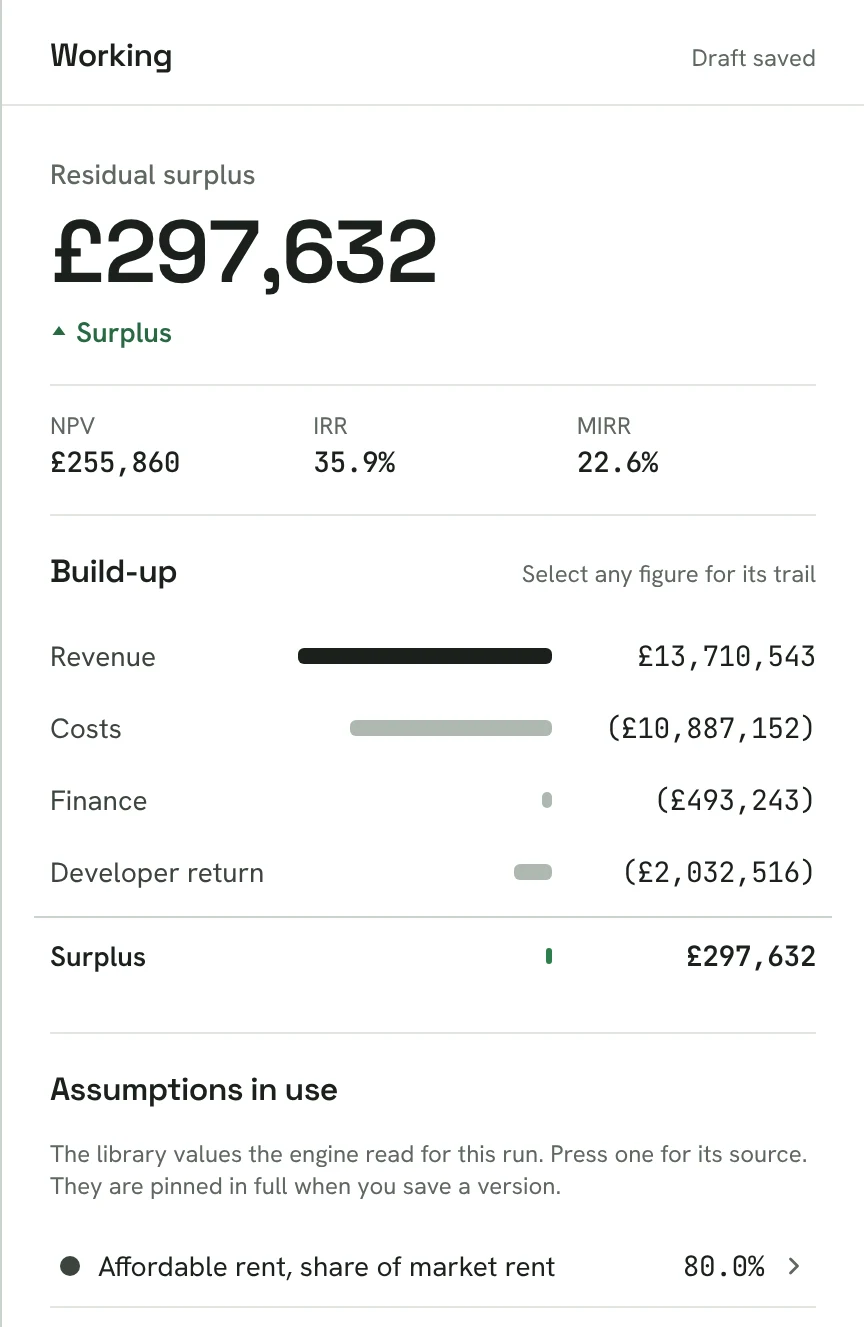
Every number shows its working.
A spreadsheet can produce a number. It can't tell you where each input came from, when it was true, or whether the result has quietly drifted. Residual can.
Trail Affordable rent, share of market rent
Source
MHCLG: Policy statement on rents for social housing
80.0% of market rent, published, effective 1 April 2011
Affordable rent apartments
- £175 market rent a week × 80.0%
- £140 a week
- £140 × 52 weeks, less £420 service charge
- £6,860 a year
- Less £1,050 management and maintenance a year
- £5,810 a year
- £5,810 ÷ 5.0% yield
- £116,200 per home
- 7 homes × £116,200
- £813,400
Effect on the residual
£813,400
One engine, three questions.
| Mode | The question it answers | It returns |
|---|---|---|
| Viability assessment | Does this scheme work at this land price? | The surplus or (deficit). |
| Residual land value | What can we afford to pay for the land? | The land value that brings the surplus to zero. |
| Affordable housing valuation | What is the affordable element worth? | The value of the affordable homes. |
Identical inputs always return an identical result.
See where viability breaks, before anyone else does.
Take 10% off capital values and a surplus of £297,632 becomes a deficit of £884,323.
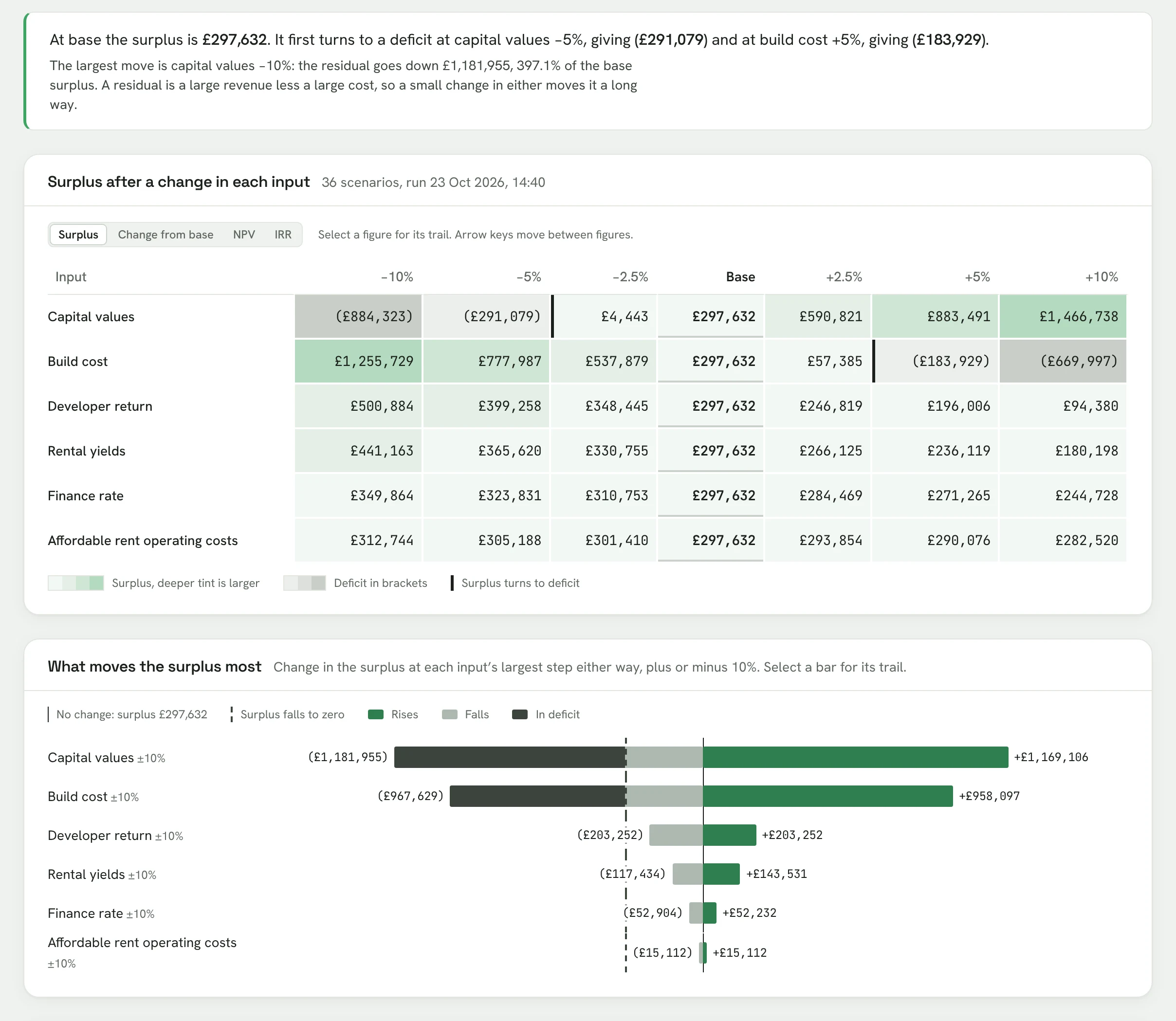
Scroll sideways to see the whole screen.
Reports people can check.
Every report is built from a saved, signed-off version, so it reproduces exactly. Export to PDF, Word or HTML. Every assumption is footnoted.
Board paper · Viability statement · One-page summary · GLA-style output
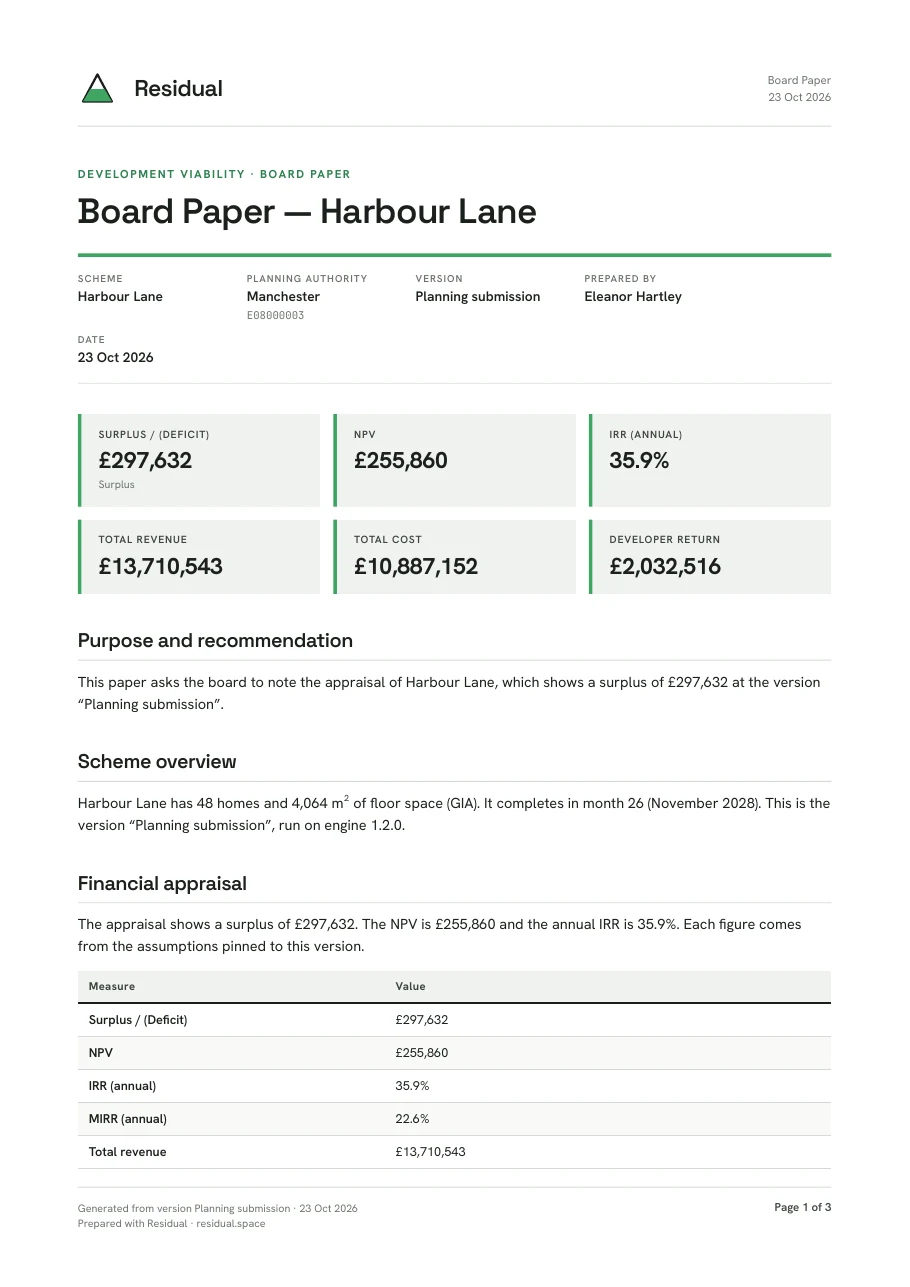
Signed off Priya Raman, Development director (fictional)
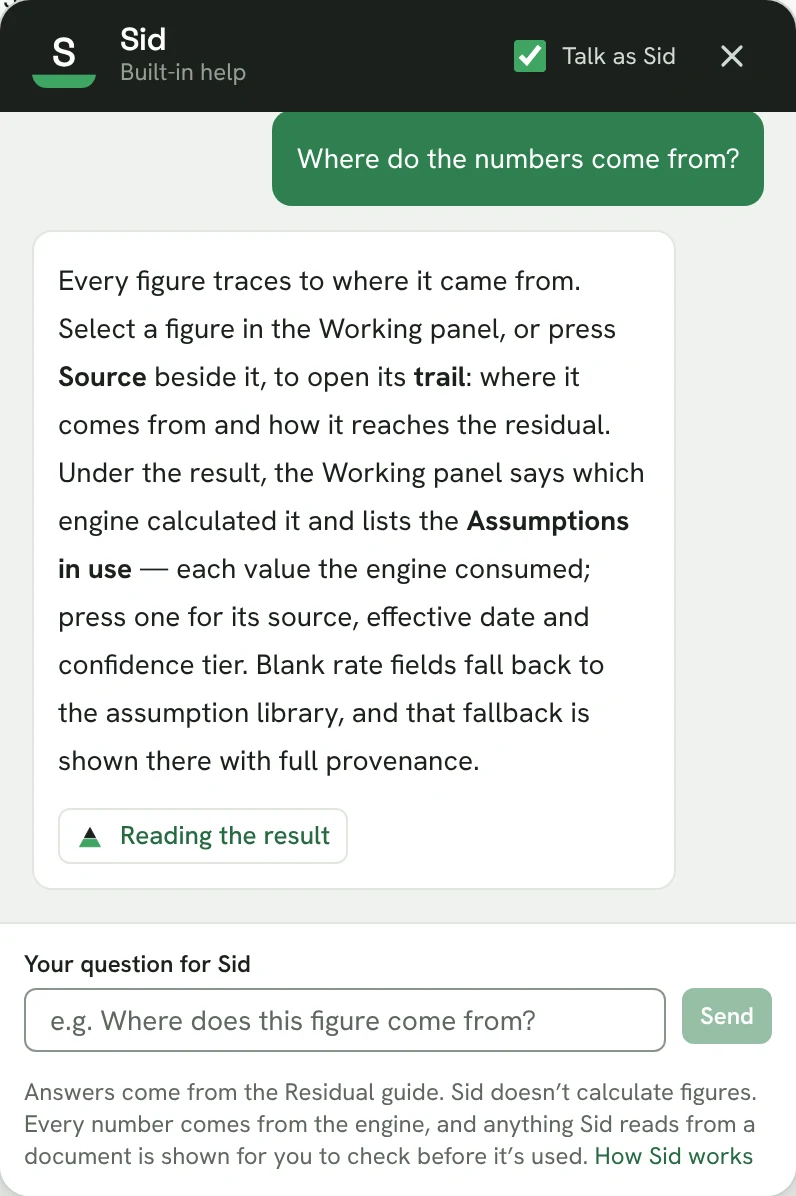
Built-in help that shows its source.
Sid doesn't calculate figures. Every number comes from the engine, and anything Sid reads from a document is shown for you to check before it's used.
Questions people ask
 Sid
Residual land value (RLV) is the price you could pay for the land and still make the scheme break even — what's left for land after all build costs, fees, finance and the developer's required return are met. In Residual land value mode the engine solves for it; it's typically compared against a benchmark land value.
Source: Concepts & glossaryResidual guide- Sid
Each value is effective-dated, scoped to a geography, and carries a source and confidence tier. Nothing enters without a citation, and nothing is ever overwritten — only superseded.
Source: Assumptions libraryResidual guide - Sid
A saved version pins the exact assumptions it used. "Stale" means one of those pinned values differs from the current library — but your saved result is unchanged: Residual flags it rather than silently updating. If you want the version recomputed on today's assumptions, use Re-base, which creates a NEW version (the original stays immutable). Re-basing is always an explicit choice.
Source: Audit, provenance & stalenessResidual guide